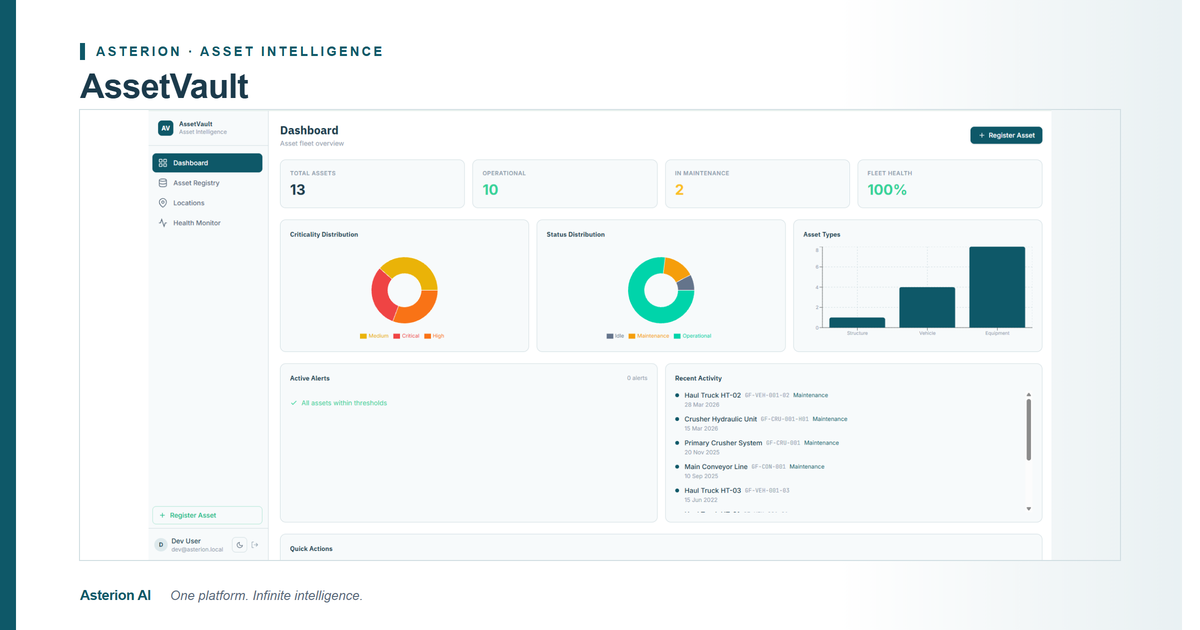
One register for every physical asset: hierarchy, lifecycle and documentation in the same place.
Download the product overview (PDF)
Asset data ends up spread across ERP, spreadsheets, a CMMS and a pile of engineering drawings. No one team can say what exists, where each asset sits in its life, or which maintenance strategy is supposed to apply to it.
Decisions get deferred and capital estimates go wrong because the picture is incomplete.
Documentation scattered across systems is documentation you can't produce during an audit.
Without lifecycle clarity, assets get replaced too early or run until they break.
One digital register of every physical asset, with unique identifiers, classifications and location mapping across sites.
Multi-level hierarchy from enterprise down to component, supporting functional, location and financial views of the same estate.
Commissioning through to decommissioning, with health, remaining-useful-life and anomaly signals surfaced at each stage. Lifecycle calls get made on evidence rather than on age.
Risk-based criticality plus a composite health score per asset, combining age, failure history, metric deviation and maintenance backlog into one number you can decompose. Reliability data from ReliCore enriches it, and statistical anomaly detection flags assets drifting toward trouble.
Drawings, certificates, datasheets and compliance documents linked to the asset itself, so they're current and findable.
Long-range replacement and refurbishment forecasting driven by condition, criticality and lifecycle rather than by depreciation schedules.
Asset Management Overview, Principles, Terminology
Asset Management System Requirements
Guidelines for the Application of ISO 55001
Publicly Available Specification for Asset Management
Reliability & Maintenance Data Collection
Risk-Based Inspection Methodology
AssetVault is the data layer the rest of the platform reads from. Asset data doesn't stay in one place; it drives what every other module does.
Criticality and lifecycle data feed failure modelling and RCM strategy.
The register drives inspection schedules and compliance requirements, so nobody is building them by hand.
Hierarchy and documentation feed shutdown scope planning, which is where most scope gaps originate.
Keep the register honest and watch lifecycle status across sites.
Build strategies against criticality and lifecycle rather than against a calendar.
Keep technical records attached to the right assets, which is harder than it sounds once drawings start being revised.
Use replacement forecasts and capital plans that are grounded in condition rather than in age.
We review what your register actually contains: how complete it is, how good the data is, and how much of the lifecycle you can see. The gaps are usually not where people expect.
Know what you have before deciding what to do about it.
Asset types and operating context change what a good register looks like.
Register completeness and data quality gaps, stated plainly.
What happens from day one, agreed before anyone starts.
 ASSETVAULT · ASSET LIFECYCLE MANAGEMENT